
One of the consequences of HSCT that I casually glossed over in the previous two years –unintentionally — was fertility, or rather the end of fertility and my reproductive capabilities. Having endured multiple miscarriages in my 30s with varying degrees of associated trauma, by the time HSCT was put forth as an option for MS treatment, my reproductive future was already a thing of the past in my mind. Increased disability, a swiftly deteriorating marriage, and the acute health concern of MS during a global pandemic meant I was A-OK to never have children. I am not posturing – I realized with tremendous reflection (and therapy) that I didn’t actually want children; a child-free life was the right choice for me.
Having said that, knowingly ending one’s cycle and messing with one’s hormones is a rather big deal. A known side effect of the HSCT treatment is the loss of your menstrual cycle and fertility. Amidst the two-days of testing and oncology consult, I was paired with my bone marrow transplant nurse, Kerry. You can read all about her in my love-fest, open letter. But one of our early, in-person conversations was about the consequences of treatment to my menstrual cycle and almost-guaranteed, total loss of fertility and menstruation and early onset menopause. We discussed the dangers and side effects and under the umbrella of “informed consent” I had to sign a legal acknowledgment of this discussion. Was I interested in delaying the start of transplant in favor of egg harvest and preservation? Unequivocally, no. In that meeting I believe I answered, “That ship has sailed. Where do I sign?”
The day I had my chest port inserted, I received a shot in the booty halting my period for three months and maybe forever. My medical team informed me this is standard for women, as losing more blood in addition to the fragile state of transplant, is ill-advised. As I was in the middle of my cycle at the time, the last day I got my last-ever period, was the day I went for apheresis to harvest my stem cells. Mother Nature was saying goodbye by giving me the proverbial middle finger on an already difficult day.
An uncomfortable Q&A
Leading up to transplant and the last year and a half of recovery, I asked questions about my cycle to every doctor, resident, fellow, and nurse I encountered including emergency, neurology, and oncology. As the 10th person to undergo this treatment at Cleveland Clinic there is a decided lack of information and data on most questions which I understood in theory but feels entirely different in practice. It’s alarming to not have an answer or even an idea.
I inquired if my period would return. If so, when? What happens if it doesn’t return in terms of hormone regulation? Am I in perimenopause? Am I in full menopause? How do I know? What signs should I be on the lookout for? I was told — and this is NOT an exaggeration — that my period would probably stop. It might come back right away. It could come back at some point. It might come back and then stop again. And it may never come back.
In my brutally honest fashion, I looked each and every medical professional in the eye and said, “So you don’t know. Why not say that?” Begrudgingly, they would hem and haw, and say something along the lines of, “Well each woman’s cycle, body and response to treatment is so unique.”
Over the course of my reproductive years I’ve learned:
- Having menstrual symptoms, period pain, irregular schedules? Put them on birth control.
- Having a miscarriage? I am sure whatever pain you’re feeling is completely normal, suffer at home, you’ll be fine. This is a natural process.
- The treatment we gave you halted your menstrual cycle. Talk to someone else because we are not specialists in women’s health.
- You want a standard hormone panel baseline test? I don’t have information on Hormone Replacement Therapy (HRT), talk to your primary care physician. Anything with the uterus = women’s health = not it.
- You want a recommendation for a provider to see to discuss these options who might know about HSCT? Just chat with your primary care provider, you have one, right? No? Well, it’s only a nine-month wait to establish care.
Educating the doctor
The funny (read: obnoxious, exhausting and demoralizing) thing about being referred to an expert in menstruation, menopause and “lady issues” is that I then bear the responsibility to educate whomever I see about HSCT, bone marrow transplant, and it’s early-stage use for treatment of MS.
I have found myself in conversation with surgeons, infectious disease experts, and clinical leaders who said, “You had what done? I have never heard of that. I am going to look that up.” These individuals are top of their game and also my colleagues and friends. I’m happy to share my story as a colleague and friend. But as a patient, the responsibility should not rest on my shoulders to educate the professional with whom I am seeking assistance. It’s incredibly frustrating as a patient to continually tell your story but it’s part of the gig as you establish care. When I am in my patient role, the same conversation arises, over and over. I appreciate their curiosity. I take the time to explain the history of HSCT and my history and disease progression with MS. But there is a personal toll — physical, mental, and emotional. And as anyone who has ever seen a doctor can attest, you’re on a truncated time table., The clock is ticking, but sure, let me fill you in on HSCT.
I know I am a medial experiment. I know they don’t have answers. I signed up for this. But I didn’t realize there was little help navigating the after effects as I saw last year when I got Shingles as a result of my weakened immune system. They pushed me in the deep end to see if I could swim.
HSCT, right now, is not for the timid. It takes grit and determination and way more personal advocacy than I believe it should.

Questions for the men
I am not close with any men who have undergone this treatment. I spoke with several in advance of transplant, but my menstrual cycle was not a discussion topic at that time. There were far larger and looming issues like death and paralysis. I wonder if they had hormonal issues. Was their pain taken seriously? Did they feel like a lab rat? If so, did it bother them? I am continually learning new things as I navigate my medical care — chronic illness and being a living, breathing medical experiment. The most recent lesson being that the world has given the medical community a get-out-of-jail-free-card regarding women’s health and wellness.
I’ve learned through my four decades on this earth and three decades of menstruation that the general consensus from medical professionals is that they just don’t know when it comes to women’s bodies, women’s health, women’s cycles, and women’s hormones. Because our periods make standardization impossible in a controlled study, its been my experience that they don’t even try pre-emptively in the planning and education stage or after for the consequences. So, the answer “I don’t know” and the “not it” mentality of women’s issues, is universally accepted. We’re too individual, complex, unique, tricky, hard, difficult, challenging, erratic, and unpredictable.
Do you know these dates regarding women’s health?
The above realization shouldn’t be shocking when the veil of inclusion is lifted. In my youth (and ignorance) I thought women were included in clinical trials. I assumed that participation had to be 50/50 for men and women, and medicine impacting me, prescribed for me, had been tested on people like me.
A new FDA guideline issued in 1993 was the first time the regulating body lifted the restriction on women, allowing them to be included in early-phase clinical trials. Congress wrote the National Institutes of Health policy into Federal law establishing the guidelines for the inclusion of women and underrepresented racial and ethnic minority populations in clinical research. It was not that long ago, when over half of the population was excluded from the research impacting the treatment of all.
As measured by the Manual Categorization System-Women’s Health reporting module, women’s health research accounted for 10.8% of the NIH budget in fiscal year 2020 ($4,466 million). 10.8%!!!!!!
That means that medications and treatments used on me have less data than years I’ve been alive. It also means for any woman receiving healthcare, the vast majority of information known is clinically based on a man’s body composition, which we all know IS DIFFERENT IN EVERY WAY from muscle mass, blood volume, metabolism, hormone regulation and you know, everything else.
In fact, every cell and organ in our bodies is affected by whether we are female or male. This isn’t just due to testosterone or estrogen. It’s because the cells in our bodies read our DNA differently if we are female or male. Women are three times more likely to get rheumatoid arthritis than men and eight times more likely to get an autoimmune disease (like MS!).
It’s a good thing we can trust marketing, oh no wait

BMJ Sexual & Reproductive Health on August 7, 2023, is the first ever study to compare absorption levels of menstrual products, including tampons, pads, cups, and menstrual discs, using human blood.
When I heard this, I laughed out loud. Remember the advertisements in the 90s and 00s where they poured blue water on a pad or a tampon? What was that, Hawaiian punch? Kool-Aid? For the entire duration of menstruation, the products created for me, touted as effective, and marketed to me from teenage years onward, were never tested with actual blood. Does this enrage anyone else?
Read (or listen) to this book
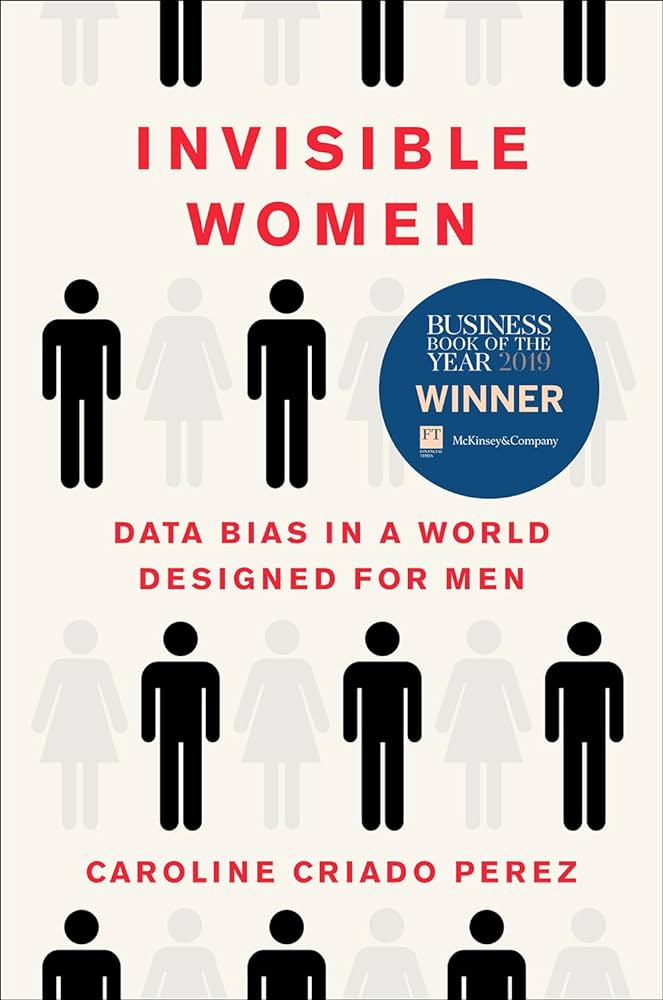
I read Invisible Women: Data Bias in a World Designed for Men in 2019 and could not believe the number of things created for all, meaning created for men. Did you know it wasn’t until 2022 that female crash test dummies were created? It’s not even mandatory in safety tests. Bullet proof vests are designed for men and often don’t fit women. The list goes on and on. Read, or listen to the audio book. We all should know the data bias, design bias, decision bias affecting every inch of our lives — men and women alike.
What’s next?
In April, I had the opportunity to watch a discussion between Maria Shriver and Cleveland Clinic’s Chief of Staff, regarding the launch of a new Women’s Comprehensive Health and Research Center, an initiative dedicated to helping women during midlife and beyond thrive and easily receive the specialized care they need. The center is focused on four key areas: access, connectivity, education, and research and innovation to empower women to navigate their health journey with confidence and clarity. Progress is happening, but change is slow.
I’m advocating, within my care team, for a better option to take care of female patients.
I’m waiting patiently for a primary care appointment sometime in the next year.
I will continually challenge where I can, educate myself, and share my knowledge.
And I hope navigating and receiving healthcare tomorrow will be less convoluted than today for all — but right now, I’m really focused on women.
 My Chronic Library