A friend asked a simple question yesterday: “How are you doing?”
I find this ridiculously difficult to answer. I bounce around in my brain wondering if they meant my health, mobility, happiness, sex life, work life, home life. I mess it up every time and say something like, “I’m ummmm errrr uh… good.” This inadequate and benign phrase is accompanied by my own furrowed brow, overall puzzled expression, and an upward lilt of my voice as if I am asking a question rather than answering one.
Why is it so hard to tell someone how I am?
In my fourth decade on this planet, I am unlearning everything. I wonder if what I feel is what I actually feel; or what I was told to feel; or what I think I should feel. In the last several years I’ve attempted to build in a pause, to retrain myself to ponder the origins of my feelings. I’m attempting to turn down the volume on societal expectations, gender norms, religious absurdity, and childhood patterns, and turn up the volume on what I think, feel, and desire.
A few brain teasers
- What age did I learn that skinny or thin meant a better body?
- Why did I always assume I would have children without asking myself if I wanted them in the first place?
- Why did I believe mobility meant desireability?
- At what point did I play less and work more at the extreme cost of health, wellbeing, and creativity?
- Who showed me that rest equals lazy?
- When did “flattering” become the end-all be-all in clothing over comfort, practicality, or personal expression?
- Who was the first person to tell me to be quieter, smaller, softer because their opinion mattered more than my own sense of self?
- Why did I believe people that told me I was too much?
I’ve struggled so hard with the changes chronic illness thrust upon me — so young, so early in life. The more I unpack how the physical changes to my body altered my self worth, the angrier I get. Maybe this is chronic illness, or disability, or menopause. Maybe it’s a big ol’ messy soup of all of it combined.
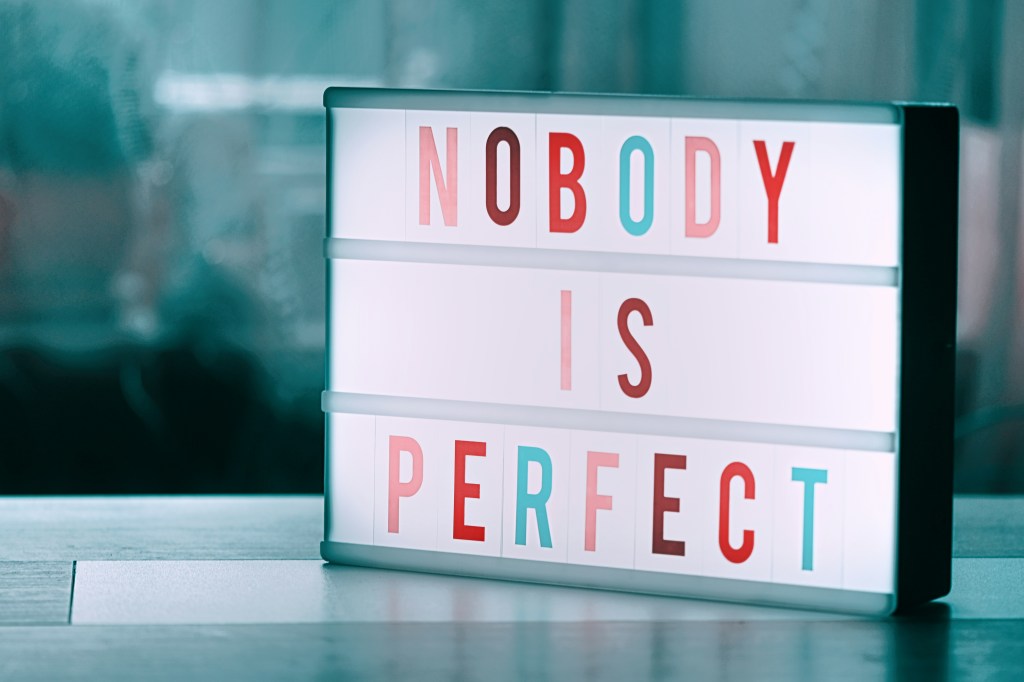
For whatever reason, in this body, in this version of me… I don’t want to be perfect. I want to be perfectly imperfect. I want to look at my body each day and be grateful — lord knows it’s survived hostile circumstances. I want to be me, unapologetically, imperfect, messy, loud, takes up space, me. I want to retrain my brain so my inner monologue is as nice to me as I am to those I love. I don’t want to be chosen.
This portion of my life is invite only – I am choosing.
In a recent therapy session, which also started with the question of how I’m doing, I responded, “Physically? Same old. Mentally? Stronger than ever.” My desire for my lost mobility is never going away. But with that loss, I’ve been forced to reevaluate life and pretty much every preconceived notion, long held belief, and more –happiness, love, marriage, sex, friendship, family, companionship, work, and my overall values.
Inspiration
I came across a list, randomly on Pinterest, entitled Gentle Prompts for Healing Perfectionism. I did not create this list but it rendered me speechless. I am resharing here.
- What if “good enough” was sacred?
- Who taught me I had to earn rest?
- What would it mean to create imperfectly?
- What would I do if I wasn’t afraid to fail?
- What if I stopped fixing myself and started accepting myself?
- What part of me still fears being average?
- What expectations do I need to release?
- When did I start confusing effort with worth?
- What does success look like when it feels kind?
- What if I stopper over-preparing and just began?
- Who am I trying to impress that no longer matters?
- What would I do differently if I trusted myself more?
- What would rest look like without guilt?
- What does “trying softer” mean to me?
- How can I be proud without perfection?
- What would I create if no one saw it?
- What does a compassionate inner voice sound like?
- How can I measure peace instead of performance?
- What would I say to the part of me that’s tired of trying?
- What does freedom from perfection feel like?
Did this list cause you to pause? Are you caught on one? Or many? I keep re-reading and coming back to a different one each time. I’ve previously written that my life is quieter. My life is smaller. My life is more local. But I used to think this life was worse because of all that was taken from me. I was living in the past, angry at my present, and neglecting my future. Warranted. Understandable. And also really, really dumb.
Perfectionism or normal or ordinary is so pedestrian. When I got sick, all I wanted was to be normal. I think, maybe, I’m figuring out that illness is driving me back to myself. I am allowed joy in my present and my future is worth significant investments.
I will never be the MS advocate loudly pontificating about how God only gives people what they can handle. Or proclaim I am blessed. If that works for you – more power to you. But for me? I’m grateful for this life. I’m appreciative of my difficult and unpredictable body. I like me. My illness is one part, but not the whole.
And, I think, my agile and strong mind is the most valued aspect of my health.
 My Chronic Library
One response to “Healing Perfectionism”
A most helpful piece, thank you Carolyn. I’ve read it once, an awful lot resonated with me, I will definitely be reading it again. Sent from my iPhone
LikeLike