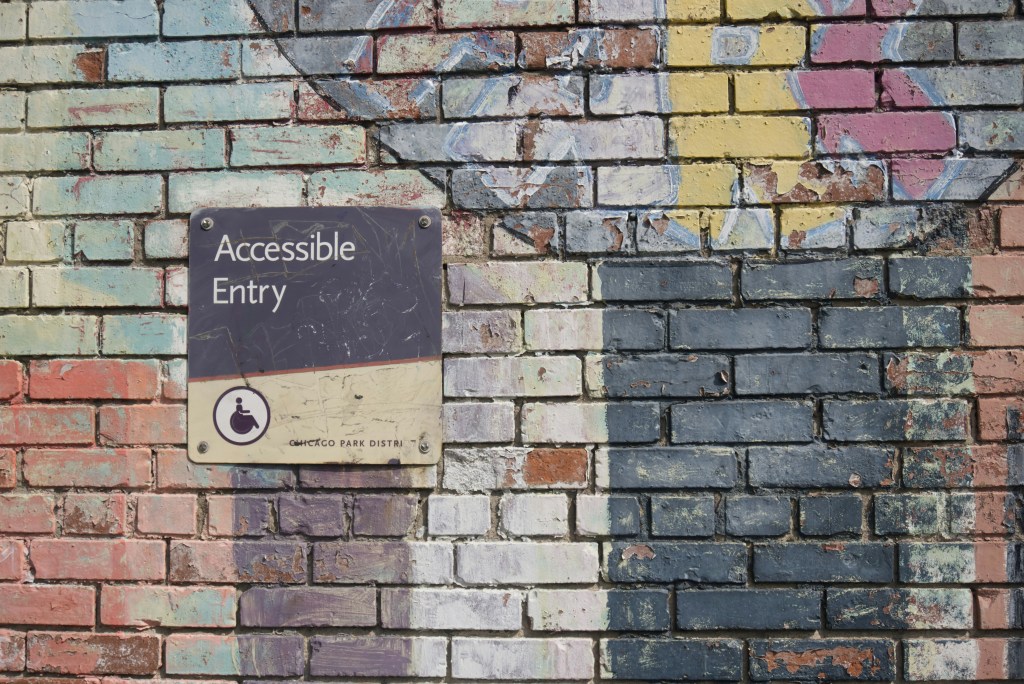
Yesterday was an amazing day because yesterday, after almost eight months of work, Cleveland Clinic published a one-stop-shop for accessibility resources and accessing care at our locations.
CHECK OUT THE WEBSITE

A bit of background
I took over as chair of our Employee Resource Group (ERG) for individuals with disabilities and their allies in January 2021. I needed a place of connection and an outlet to escape all COVID, all the time at work. I was looking to join, listen, and learn. But they were looking for someone to lead — so I did.
What I found were individuals who were allies or who had family members with disabilities, but not individuals working at Cleveland Clinic, who identified as having a disability. Where were my colleagues who were like me? I knew they existed. With more than 75,000 employees at the time, there were more employees with disabilities who were probably facing similar challenges both personally and professionally. Like me, were they afraid of being othered, feeling different, being judged for my differences rather than celebrated for my uniqueness? Or unlike my experience, were they hiding under the tyranny of a bad manager and dismissive team? Did they feel they somehow had to show or prove their disability in order to be heard and seen? In order to deserve accommodation? Did they know our group existed; how to find us and how to join?
I assumed the chair position with no road map, a few resources, and joined a group of individuals who were invested in answering questions but no one who was able to share a how to — specifically for someone WITH a disability. Frustrated in the moment, then urged by my own “I’ll figure it out” attitude, I set out to create a different ERG.
Rather than focusing on patients (which is the North Star for everything at Cleveland Clinic), I wanted to focus on employees – we call them caregivers. I wanted to create a safe place to ask questions, receive guidance or recommendations, and provide caregivers with disabilities expert knowledge to navigate ADA laws, resources that exist at Cleveland Clinic, and connection so nobody feels alone. I’m biased here, but there are few things that induce loneliness more than navigating chronic illness and disability. I didn’t know the right way, in the moment, I just did. This leadership role was not my day job — I still maintained that. This was done in addition to my work. I was not compensated for any time spent.
As someone who loves a strategy, this was fueled by passion and personal experience not an outline, goal, or OKR.

Looking back, I did the following straightaway:
All of our ERG meetings would be virtual. This was already in place when I joined and easy to continue in the height of COVID with remote work, masking, and social distancing solidly in place. But the remote option opened up a world previously closed to many with disabilities, from mobility issues to compromised immune systems, this was inherently a more inclusive option for our caregivers around the United States and world. I’m all for in-person meetings — when they make sense — but if you want to be inclusive, give people the choice of virtual attendance.
All meetings are recorded. Our hospitals span four countries and most operate on a 24/7 basis. It’s unfair, and certainly inequitable, to offer these groups and meetings solely for salaried employees with flexible schedules who work traditional business hours. If you’re a part of the group, you can watch the recording of our meetings, comment in our TEAMS channel, and more… on your own time. It’s also important to note that our HR policies describe ERG participation as “protected time.” A fact that managers need to be reminded of all the time.
Recorded, but with a non-recorded space. The above has a caveat. Disabilities are personal, discrimination is more so. Fear of retaliation is real. Fear and uncertainty are prevalent as we spend so much energy appearing normal, hiding our disability, ignoring it in favor of acceptance. I got used to minimizing my illness and disability to make others more comfortable. We needed a virtual space that wasn’t documented, in order to air grievances and get real help.
At the end of each meeting, we stop the recording and transcript, and offer space for anyone in the group to ask a question, share a story or experience, and get connected. Often the members are feeling othered, bullied, discriminated against, or are in fear for their jobs and retaliation. We openly talk about what is legal, what an employee’s rights are, and who they can connect with for more information.
It’s important to note that our ERG has members from our legal team, our Title IX coordinator, and the group that receives reasonable accommodation requests under the ADA, not to mention many professionals in talent acquisition, recruitment, and HR. It goes without saying, but I will anyway, this group is diverse, spans locations and responsibilities, includes hourly and salaried employees of varied education levels and professional background, and is open to all, no matter what.
I am no longer chair of our ERG, but I am still an active member. And this safety, above all else, is my legacy. I get random TEAMS chats, emails, texts, and phone calls from caregivers I’ve never met. They ask for council, advice, and someone to hear their woes. Most importantly, I offer confidentiality. I am outside of HR. My loyalty lies with helping them, not protecting the company. Also, with so many employees, there is anonymity in talking to me — someone they will probably never professionally interact with outside of our ERG. I have no problem or hesitancy in escalating an issue, a story, or an experience to those in positions of power who can affect change.
My heart swells each time I provide a safe space because I remember navigating my disability alone. I wouldn’t wish that on anyone.
Use the group for info gathering. This should be a no-brainer but isn’t. The members who join a group committed to enhancing and improving the experience for individuals with disabilities, know more and see more. They experience the world differently, and therefor their expertise should be tapped into to improve everyone’s experience. We’re a hospital, shouldn’t we be leading the way in improving access for everyone? Shouldn’t we be showing other organizations and companies the benefits of inclusion? We have resources and knowledge to improve the patient experience and the employee experience because our employees are patients too. Our ERG needed to be a space to identify issues and action items. But more than identifying them, we needed action and resolution. Otherwise, we were just talking to ourselves.
Nothing about us without us
Have you heard that phrase? Don’t exclude us in the decision making process and then tout that you are an inclusive environment. Don’t preach about belonging and ignore the largest marginalized community in the United States. Don’t believe me? Up to 1 in 4 (27%) adults in the United States have some type of disability according to the Centers for Disease Control and Prevention (CDC).
Don’t make architectural designs without consulting someone who has mobility issues. Don’t tout your accessibility services without seeing if they actually service the individuals who need them. This applies to all companies, businesses, groups, organizations, gatherings, and all other entities. Think about a life outside your own experience. Be invested in making it better for everyone, not just yourself. Walk, stumble, wheel a mile in someone else’s shoes. Because I can tell you, I fight tooth and nail for every damn step I take. So I am making decisions about where I go based on how many steps I take. And that decision begins with the knowledge of what is required of me. If you don’t include that info, or I can’t find it, chances are I am opting out of whatever you’re offering.
Don’t take feedback as an attack. Take feedback as an opening to a productive dialogue geared towards improvement.
My access and privilege demand attention and action
Not every member of the ERG has the 30,000 foot view of the organization that my job provides. I support our executives. I have meetings with decision makers. I have formed long-lasting friendships with professionals in every arm of our operations. I tell my story. I share my disappointments in a broken system. I educate through storytelling. I ask questions about how to improve. I recruit allies.
Healthcare is a universal need. Healthcare begins with access. But if you don’t talk about the barriers to access (and there are many outside of my knowledge and experience) nothing changes.
Accessibility resources on our website
Wow, did I bury the lede or what? Did you make it this far? I was able bodied and entirely without mobility challenges when I began my healthcare journey at Cleveland Clinic and when I began my employment. I had the knowledge of walking every inch of our 170-acre main campus and many of our regional hospitals. So when my mobility changed — drastically and swiftly — I already knew the services available and how to get help.
One of our ERG members pointed out during a meeting that Cleveland Clinic — a world-renowned hospital system — didn’t have an accessibility webpage of services. If you Googled “Cleveland Clinic and accessibility” it brought up a page for our Toronto location. (How embarrassing!) I took my knowledge for granted. I went on a deep dive, with members of our ERG, to find a good example of resources at a hospital. Spoiler alert: most are awful. We looked outside of hospitals for what information needed to be shared and how someone searching for this information would find it.
I brought the need (or gaping hole) to a leader in marketing who after hearing my case replied, “I can’t believe we don’t have this already.” Not unkindly I responded, “We should be embarrassed. But I’m not at all surprised. If it doesn’t affect you, it’s not on your radar as a need.”
That leader committed on the spot to rectify the situation and allocate resources to write the website copy, gather resources, build the web page, and publish.

For eight months I worked with the writer, connecting them to clinical experts, buildings and grounds, operational support systems, and individuals who have disabilities who would seek information on how to access our services. Rather than writer, I acted as initial editor for the disability experience.
We had candid conversations about removing the word “just” as a qualifier on any web copy. As in “it’s just a few steps” or “just ask for directions” or “it’s just around the corner.” Using just as a qualifier implies that the person speaking understands the challenges of the person asking the question.
Don’t presume — specifically in healthcare — that you know what anyone is going through. Provide clear information without judgement. Arm the individual with the knowledge to make their own decisions to plan accordingly.
I gathered individuals from the ERG who had been a part of the process from the beginning to review services. We wanted to gut-check that we were welcoming, inclusive, and answered questions. Doing this brought about things once again that I hadn’t thought of. One member included a comment in tracked changes asking “What about getting food? Is that accessible?” I had no idea. I had thought about parking and bathrooms and wheelchair assistance but missed the rather necessary element of eating and drinking! Share these pages far and wide. Get lots of eyes on them. Solicit feedback.
Lastly, I know it’s not perfect and there is a way to go. All of our hundreds of locations are not the same in terms of accessibility but it’s a place to start and grow. Don’t let perfection be the enemy of good. We all have to start somewhere; we all can improve.
Listen up to those who are willing to get loud.

But for real, visit the website and tell me what you think. Did I miss anything? Was it easy to navigate? Do you have a better understanding of available services?
I am not perfect. I want to learn. Please share your thoughts.


4 responses to “Accessibility For All – put it on the website”
Carolyn, this is absolutely fantastic! I will look at the website but before I do, I wanted to acknowledge what an enormous task you did for so many. And to deeply thank you. You addressed many many issues, everyone from executives down will be helped by this resource. Especially at a hospital, this is vital. I did have to chuckle at “just”, as what you stated was very true, in many cases in my own experience too.
With all my love & gratitude, Catherine
Sent from my iPad
>
LikeLike
Thank you, Catherine. I so appreciate your feedback. Someday we’ll have that proper tea and catch up.
LikeLike
Everything is perfectly stated. Your commitment to moving things forward is a gift you share. I continue to learn from you and I am so grateful. So many great wise words to make things better for everyone.
LikeLike
You are a huge support and great colleague turned friend. I’m glad we are fighting together.
LikeLike