
Four years was a good run, but that nasty little bugger finally got me. I joined the masses and tested positive for COVID. I’m getting used to this unpredictable body of mine, but no matter my comfort with variance, I will never get used to total paralysis at the drop of a dime.
Saturday
In the morning, I woke feeling punky, achy, and generally low energy, but living with MS, that’s nothing new. By the afternoon, I had a sore throat. This raised the alarm in and of itself as apart from my volatile neurological system, I don’t really get sick. I’ve never had strep throat and it’s been years since I had a sinus infection, so a sore throat was irregular to say the least. I decided to take an at home COVID test and low and behold, there was a super faint line. Welp, that was that. I notified friends and family and all those I had been in contact with. I rested, made dinner, and emptied the dishwasher, and got ready for bed on the second floor of my house.

Around 10pm I got chills and started violently shaking. I woke at 11pm with a fever of 101 degrees, vomiting, chills, and almost total paralysis. My legs always take the brunt but this time, my hands were completely numb, and I was in a bad way. In times of crisis, I get really calm, eerily so. I had been here before, so I immediately went into action planning and problem-solving mode. I knew I would need to call 911, get an ambulance ride to the hospital, and probably be admitted. I knew my doors were locked and my neighbors were asleep. I figured it out, my glorious bestie and her lovely husband arrived in masks to pack my hospital bag, unlock doors, and meet the ambulance and EMS after I rang 911.
For those who are curious, yet again my EMS team was pretty hunky. What are the hiring practices in my city? How are gorgeous, tattooed, diverse men the only kind they have on staff? Not complaining, just dumbfounded.
One short ambulance ride to main campus at Cleveland Clinic later and I was uncomfortably ensconced in the Emergency Department (ED). I understand they are designed for a different purpose, but damn are those beds the most uncomfortable things to be on for five minutes, let alone 15 hours. Alone and always my fiercest advocate, paralyzed and ill, I set about getting the treatment I needed.
Know Thyself
Readers will remember last year’s viral escapade with Shingles. I was kept in pain as they tried less effective medications, had no idea what was going on, was terrified, and angry. I also fought with insurance and my employee health plan to get the care and coverage I needed to regain the ability to walk after subsequent denials based on nothing. This time could not have been more different with my knowledge, how I advocated, the openness of my care team, insurance approvals and more. Also, is it weird that I really like the new Cleveland Clinic hospital gown design?

The first attending physician in the ED came in, sat down and said, “You have a very interesting medical history. Tell me what you need.” After an open discussion about current symptoms and ailments I conveyed that the critical thing I needed was to get my pain, shaking, anxiety, and general body distress under control. The longer I was kept in pain and acute distress, the more severe the damage and the longer the recovery. I spoke up and they listened. The only thing to date that does this for me is fentanyl. I wish it weren’t an opioid, but I am not messing around with time-to-treat and time-to-relief.
Using an ultrasound, they placed an IV in my right arm and quickly administered fentanyl as well as anti-nausea medications. Hours later, with relief from pain but lingering head and neck issues and a pounding headache, I received an IV “headache cocktail.” When I say this was magical, I am not exaggerating. It’s a liquid mix of saline, electrolytes, magnesium, and a small muscle relaxer. OHMYGOD! The instant relief, instant relaxation, instant “feel better” was beyond compare.
Waiting for a Bed
The hours spent alone in the ED are some of the longest and loneliest of my life. I’m used to being alone, being my own medical advocate but there’s just something so traumatizing about the ED. Just to be clear, even when I was married, I handled this without help. Even with a friend or parent, I am still the person communicating. Even in pain, I remember dates, medication names, and my medical timeline.
I asked who the attending neurologist was on service and in a crazy twist of fate it was the same doctor who treated me for Shingles. Cleveland Clinic is a massive healthcare institution so the chances for this to happen seem pretty low. He walked in, gowned up in COVID protocols and full PPE, and fist bumped me saying, “Carolyn, we have to stop meeting like this.” The immense relief of NOT having to tell my whole damn story and rehash my entire transplant history was a gift.
Everything about this encounter was different.
Each doctor asked my opinion, and we discussed the pros and cons of treatment and tests. There was nothing told to me; everything was a partnership. For instance, he asked if I wanted an MRI to rule out an MS attack. As this was clearly onset from COVID and the viral infection, I did not. I asked if there was a clinical reason he wanted an MRI. If we did it, how could it be useful? We agreed an MRI was undue stress and strain on my already battered and bruised body. He also told me he was texting my neurologist, Dan to fill him in.
- Asking what I needed rather than telling me what they would do? CHECK.
- Partnership and agreement for treatment? CHECK.
- Coordination of care with my regular neuro team? CHECK.
- Great bedside manner with a touch of levity in a stressful situation? CHECK.
- No expensive and unnecessary imaging? CHECK.
Note to any doctor/clinician reading this: There are few things that feel better than knowing you are being talked about as a patient. The palpable relief I had knowing Dan would be updated and part of my care plan and that all doctors were talking, and the burden of communication was off my shoulders, was immeasurable and invaluable. Coordination of care across one’s team is the gold standard.
Moments after the doctor left my ED room, I received a text message from Dan checking in on me. Seriously, could he be any sweeter? I feel like I hit the neurologist jackpot. (Dan if you’re reading this, I am sorry I ever even talked about breaking up – you’re wonderful in every way and an absolute dreamboat.)
Paxlovid ASAP
Having worked on COVID-19 vaccine and medication communication for more than two years, I knew I was a candidate for Paxlovid which is an oral medication that helps mitigate COVID-19 infection from worsening or becoming serious but has to be started quickly after symptom onset. I received my first dose in the ED. There was never a question from me or my medical team that taking this to help was the right choice. Not everyone is a candidate, but if you have any underlying health conditions, look into it. Worst thing about it is that it makes things taste like metal. But even that pales in comparison to chemotherapy, so in my mind, 100% worth it.
Inpatient Admission
In the beginning, I had a solo room and was pretty much left alone. I guess there is an upside to being COVID positive? Anyone who has spent a night in the hospital can attest to the countless stream of interruptions, vitals, beeps, dings, and knocks. Everyone that entered my room was in full PPE which was a stark contrast to the ED where one of my nurses didn’t even wear a mask. I couldn’t make sense of what the current safety protocols were, so I just stopped trying.
By the time I was in my inpatient bed (a brand-new hospital bed that had phone holders and USB chargers IN THE BED!) I was walking with my trusty rollator again. Every time I bounce back it shocks my nurses. Unfortunately, I was still in pain and COVID symptoms were worsening. In 48 hours, I went from paralyzed to walking to paralyzed again.
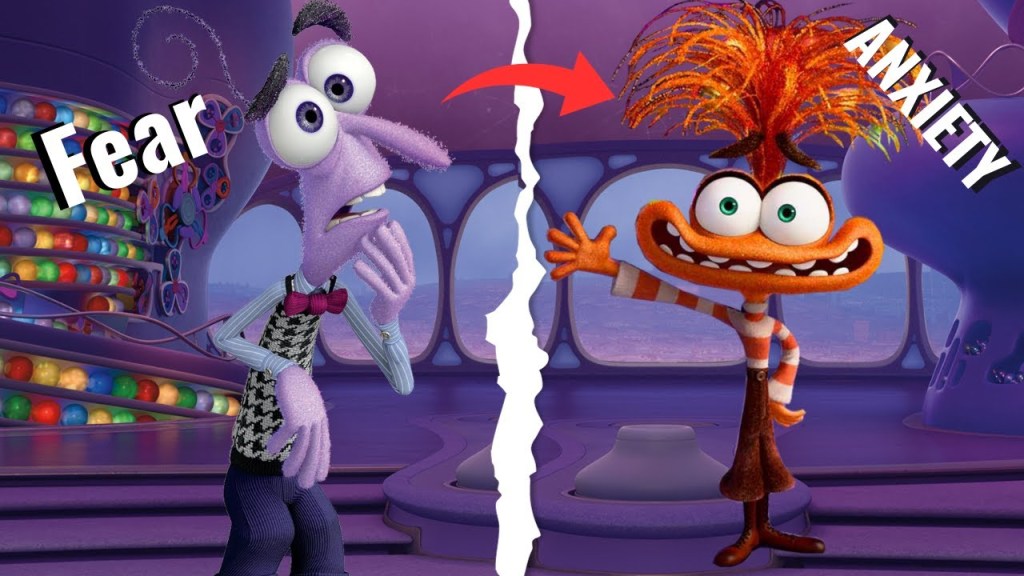
Monday night was a dark time. No amount of knowing that I needed to calm down could assuage my rampant anxiety. Anxiety and fear were running the control panel. (Thank you, Pixar for giving me visuals to what was happening.) I was crying, hyperventilating, and terrified. I was boomeranging and blindsided by the recovery and swift decline… again. Logically I knew it would pass but there was no logic, only emotion.

Eventually I bounced back again. The attending physician on neuro service switched from the doctor I knew to ANOTHER DOCTOR I KNEW. Despite a truly awful situation, the universe had my back. Working at the same place you get care is very, VERY weird. The new attending was a woman I had worked with for more than five years. And despite partnering together on many projects, being on TEAMS calls, and exchanging emails, we had never met until she rounded. We chatted, talked about my history and care plan and she asked if I needed anything. I made an off-handed remark about needing a decent cup of coffee (come on Cleveland Clinic, that shit is terrible). Without hesitation she goes, “Oh I can bring you one. What’s your Starbucks order?”
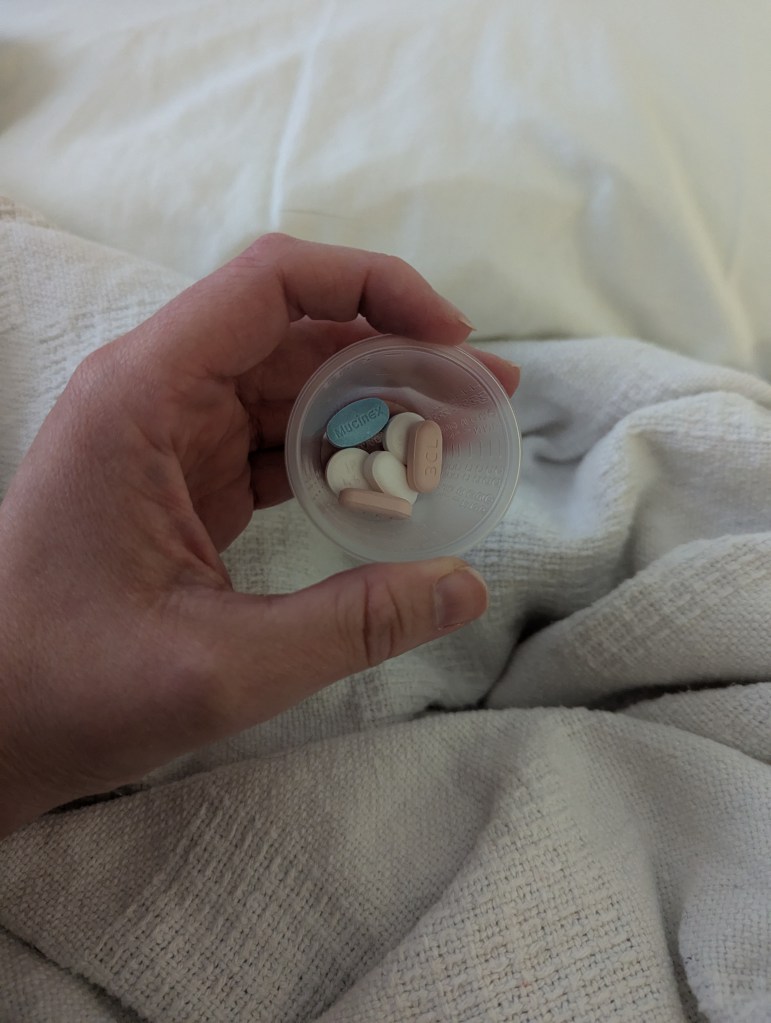
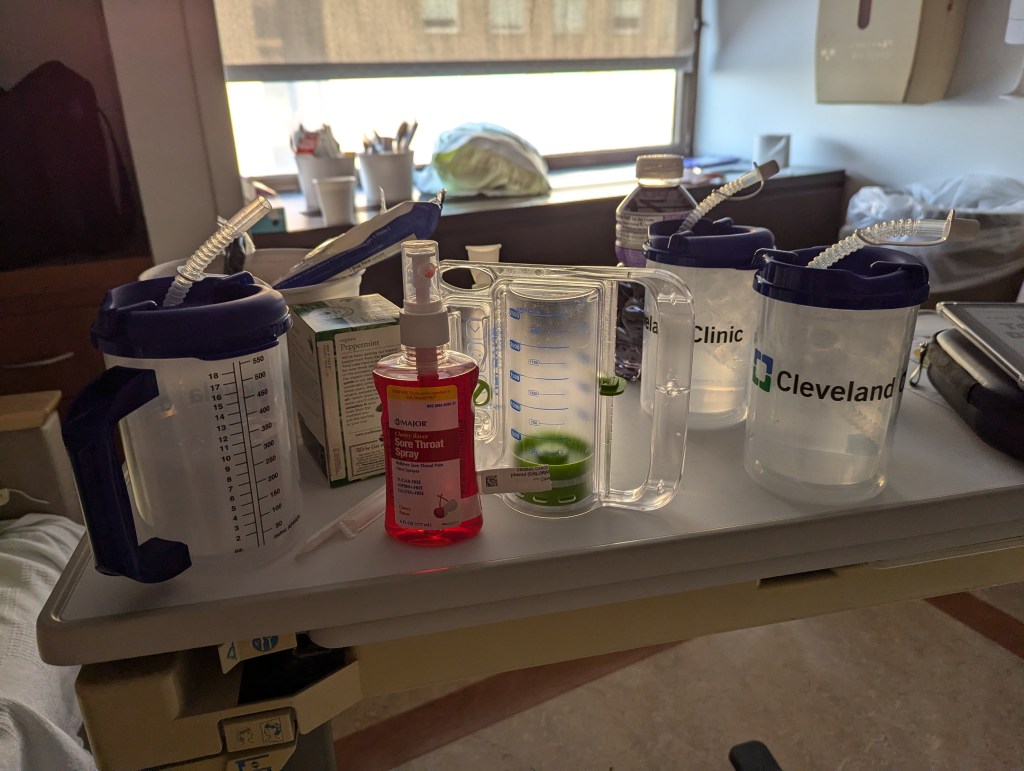

I realize the privilege in both my medical/health literacy and ability to advocate, and I also acknowledge that it is not normal to have a colleague/friend happen to be your attending physician in the hospital AND volunteer to be a goddess/savior and bring you Starbucks while you’re quarantined with COVID. But that’s what happened. Kindness comes in so many forms.
Unlike last time, Physical Medicine & Rehabilitation as well as physical therapy and occupational therapy were aligned in recommending that I go to acute rehab. I was prepared for subsequent denials and a lengthy insurance process. SURPRISE, that did not happen. In fact, insurance approvals came through in less than two days. My Shingles/ED doctor looked at me and said, “I’m fairly certain they recognized your name and are afraid of you.”
I can’t think of a better compliment to receive.
I waited for a bed in acute rehab and once again I find myself with the uphill battle of relearning to walk. I did it before; I can do it again. But seriously, can it be someone else’s turn? To state that I am over this is an understatement. It’s wildly unfair, pretty shitty, and just plain awful. It’s also my life, my circumstances, and the hand I was dealt. I will never accept that I can’t recover. I will honor how I’m feeling and also keep resetting my emotional barometer with each new day.
Chronic illness is exhausting. When asked how I was doing via text message yesterday, I replied, “Equal parts fine and terrible.” That pretty much sums it up.

 My Chronic Library