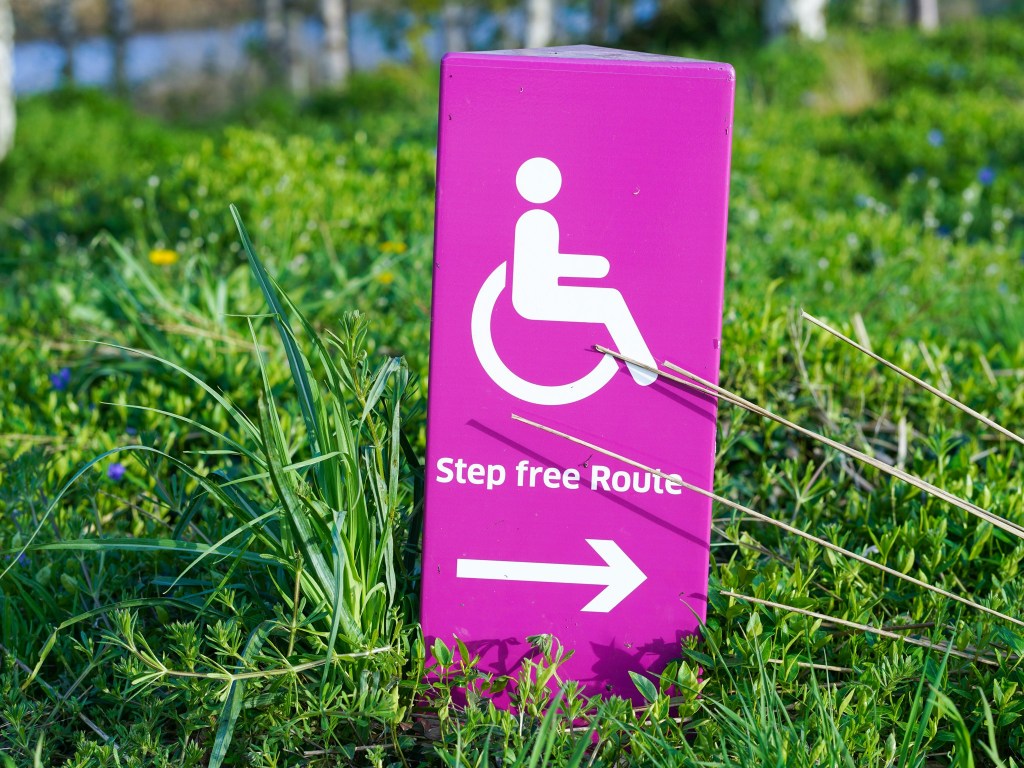
As I have slowly lost mobility over the years, I’ve learned how inaccessible our world is, and I don’t just mean physical structures. Until you go to a restaurant or venue with me (or someone else in your life with a disability) or have seen me ignored or dismissed by someone talking in a group because I’m in a wheelchair and not at eye level, most are not aware of the disability experience. People tend to be unaware of their bias and generally take for granted the ease of able-bodied living.
My eyes were forced open, and what I see is heartbreaking.
Physical disability does NOT equal mental disability
During my recent stay at acute rehab my case manager began communicating my health status and potential discharge details and timeline with my sister. I only found this out because my sister assumed she was receiving this information after it was conveyed to me and wanted to confirm we were aligned. I was instantly angered and set about righting this wrong and explaining the facility’s egregious oversight and its implications.
I spoke to the nurse, several doctors, and my occupational and physical therapists. The young case manager came into my room (having been informed by many individuals that I was angry) and said, “I assumed because you put your sister as a care partner, that it was ok to speak with her.” I was both calm and angry — which I’ve learned is a dangerous but effective combination.
I informed the case manager that there is absolutely nothing wrong with my mind, my decision-making capabilities, or my executive function. I am relearning to walk which is frustrating and demoralizing but has no impact on my ability to hear, think, learn, strategize, or speak. Never, and I mean never, make a decision about me, without me.
I informed the case manager that while my sister is a glorious and wonderfully helpful person, she doesn’t live with me. She is not on call 24/7. My discharge is dependent on me feeling safe in my home. I further expounded that only I knew my current health status, capabilities, and the day-to-day workings of living with a disability and constantly assessing what I can and can’t do. I informed her that bypassing me as the patient and discussing my medical details without my consent is a HIPAA violation not to mention hurtful and insulting. She carelessly assumed physical disability was the same as mental incapacitation with her thoughtless actions.
The bare minimum
The common phrase in the disability conversation is “nothing about us, without us.” It’s glaringly apparent that construction and architectural design is predominantly created by able bodied individuals with minimum if any, consult to someone needing accommodation. As if the requirements of the Americans with Disabilities Act (ADA) are a check list to complete in order to win a participation trophy. The ADA, which individuals fought and advocated for with their blood, sweat and tears, is the bare minimum not the gold standard. Wanting accolades for adhering to the dictates (aka the law) of the ADA is equivalent to thinking you are a great person just because you didn’t commit murder. There are so many layers. And there is so much opportunity to go above and beyond the bare minimum that benefits everyone.
- Have you ever noticed where ramps are in sidewalks? They are usually at the ends of blocks if they are there at all.
- Have you ever seen shopping carts left in a parking lot in the accessible parking spaces or the extra space to unload from a van? Put the carts away where they belong so other people can access what you take for granted.
- Have you ever been to a restaurant and had extra chairs, rubbish bins, and packages lined up on the back entrance ramp blocking entrance for anyone needing the ramp? I’ve heard servers, hosts, and managers say, “No one was using it so we didn’t think it would be a problem.” Inaccessibility and inequality is in fact, a very big problem.
- Have you ever been in a wheelchair in the middle of crowd where no one moves out of the way? I tap, shout loudly, say excuse me and ask people to move and they still look at me like I am inconveniencing them!
- Have you ever tried to use an accessible bathroom and noticed there isn’t a motorized button and the door is ridiculously, and unnecessarily heavy? Or that there is a lip or barrier from carpet to tile to get into the room? I wish people would sit in a wheelchair and try to open a door without help.
- Have you noticed where accessible door openers are located in and outside of buildings? They are often as far away from the door that is opening as possible and are never open long enough to maneuver around to use this function.
- Have you been to a hotel and were booked into an accessible room? Was the bathroom counter clear underneath so a wheelchair can go under it? Was the mirror tilted down so someone in a wheelchair could see themselves? Was there a shower seat? Did it have arms or bars for transfer? Was the detachable shower head within reach from a sitting position or by default placed at the top? Or sometimes, the shower head is on the other side of the shower from where the seat is placed.
- Public venues have a minimum amount of accessible bathroom stalls that are almost always the farthest from the door. Ever looked at where the paper towel, hand dryer, or soap dispenser is related to an accessible sink?
The everyday logistics of life — normal human experiences – are dismissed without a second thought.
Universal design
The most disturbing thing to me about these examples is that adding accessibility options and being smart about them helps everyone. Individuals pushing strollers or grocery carts benefit from ramps. Heavy doors are difficult for children, elderly, and people with their hands full. Putting bars, shower seats, and handheld sprayers ensures that anyone who needs a toilet or a shower (you know everyone) is safer and more independent. Railings make sense for balance, bad weather, illness, and more.
A friend of mine I went to college with, Katy Sullivan, was nominated for a Tony Award last year for her role in Cost of Living. She was born a bilateral transfemoral amputee, missing both lower legs. Katy is also a four-time US champion in the 100 m. and was among the first bilateral above-knee amputees to compete in the Paralympics in ambulatory track when she ran in the London 2012 Paralympic Games.
Katy is a phenomenal actress, a fierce advocate, and an all-around wonderful person.
I remember listening to a podcast around the Tony Awards where she discussed her experience with the televised award show. They had her do a walk-through of the venue in advance of the awards to ensure everything she needed was in order. She requested and was granted a clear railing on the side of the stage she would use if she won. In the podcast Katy pointed out that even after the discussions, there was only one railing. The other side of the stage did not have one.
I remember reflecting on all the awards shows I’ve watched where famous people are struggling with gowns and in heels or slip or trip going up the stairs. Why not just have railings?
Non-binary abilities
The other glaringly obvious oversight about accessibility in general is it is designed with two extremes in mind – completely able bodied and in a wheelchair with someone who is able bodied to help. It does not account for someone who can walk, but not far. Or someone who is using a rollator, not a wheelchair. Or, God forbid, an independent individual who does not have a 24/7 caretaker. Gasp! Cue head tilt and condescending voice saying, “Do you still live alone?”
There is an entire spectrum of physical abilities present in everyday life, but the world wants the extremes.
Let me reframe this issue
Over one in five Americans, approximately 54 million people, have some type of disability. People with disabilities are the largest minority group in our nation. It is the only minority group that any person can join at any time. Making places and homes accessible is good for everyone. I never thought I would be diagnosed with MS. Once diagnosed, I had no idea how my disease would progress. Once it progressed, I had already made major life decisions that impacted my independence. For the better, I had a career in communications with copious remote job opportunities. For the worse, I live in a multi-story home built in the 1930s with little regard for accessible entrances, stair height or open doorways to fit a wheelchair.
People age. Abilities change. Injuries happen. Wouldn’t it be a wonderful world if the ever-changing nature of life was considered in design and accessibility? Wouldn’t it be amazing if things were made to make life just a little bit easier for everyone?
I feel I should also mention there are 10,000 other types of disability that I am not aware of like being low-vision or blind or neuro-divergency and extreme sensitivity to light and sound. We all have challenges and I’m doing my best to recognize how others move and exist in this world so I can be a better ally and advocate. I invite you to do the same.
Not to steal the Department of Homeland Security’s line but seriously, if you see something, say something. Don’t wait for a person who needs the thing, the ramp, the door to get help.
Speak up and help us out.


2 responses to “Ableism and Universal Design”
Oh my goodness Carolyn, this blog post certainly was certainly relatable! With the dwarfism, so often peop
LikeLike
Love all of your posts. This one speaks to my heart and soul! Not sure if you know I messaged CCF communications te
LikeLike